

Visit the Hidden Hills/Aspenwood AOI MPART site for the most up-to-date information. Join the Cascade Township PFAS AOI Interest E-mail List for future PFAS updates.
Leah Gies is the EGLE Lead for this area of interest (AOI) and can be contacted at giesL1@michigan.gov or by calling 616.215.4781. Point of use water filters are available at the Kent County Health Department.
What started this investigation?
A homeowner on Aspenwood Drive tested their drinking water well independently and results showed PFAS levels exceeded criteria for PFOA. They reported these results to the health department and EGLE began sampling drinking water wells nearby and receiving results in October 2025.
In January 2026, a replacement well was put in on Colchester Drive and was tested for PFAS as part of the permitting requirements with the County. The test results identified PFOA at 10 parts per trillion (ppt), above the state criteria of 8 ppt. Based on this result, EGLE expanded the state-funded testing to include 95 more homes north of the original state-funded sampling area to 30th Street. A community informational meeting took place on February 19, 2026 at the Wisner Center (2870 Jacksmith Ave). Invited residences will received a notice of the meeting, initially scheduled for January 20th but rescheduled due to incliment weather, via mail. MPART, the Michigan PFAS Action Response Team, presented a powerpoint and answered resident questions.
What properties are included in the sampling area?
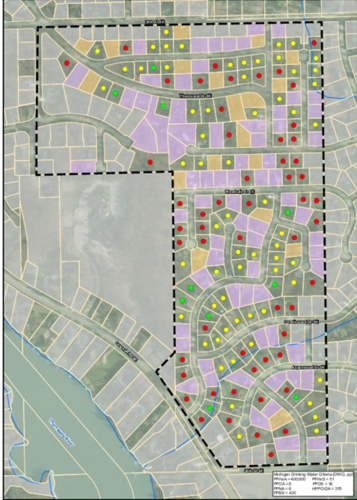
How has EGLE decided which drinking water wells to test?
There are a few factors effecting which wells are targetted, including:
- Proximity to previous sampling results (starting from the first house tested)
- Elevation, well depth, and soil lithology
What have tests shown so far?
As of February 2026, 127 residential drinking wells had been sampled with 55 homes indicating detections above criteria, 62 detections below criteria, and 10 homes without detections.
Who/what is responsible for this PFAS?
While PFAS has been found in the water, EGLE has not been able to determine the source. For the most up-to-date information on their investigation and possible sources, visit the MPART website.
What's next?
EGLE will continue their investigation into the impacted area and attempt to quantify the extent of the pollution. They are also looking for the PFAS's source but that may be impossible to pinpoint.
Long term solutions employed at other sites include providing municipal water, replacing wells, and source removal/remediation. It may be years before enough research has been done for remediation can begin but EGLE, the Kent County Health Department, MDHHS, and Cascade Township are working together to investigate this relatively new site.